Showing posts with label 1950s. Show all posts

Tuesday, November 23, 2010

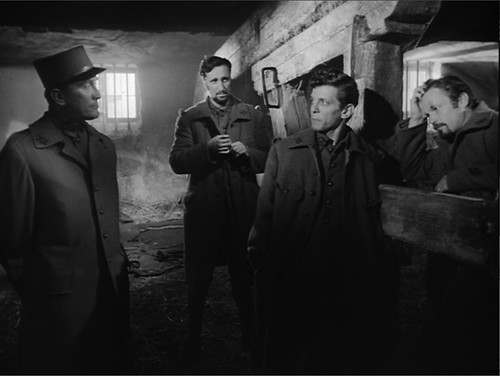
Smiles of a Summer Night (1955)

Smiles of a Summer Night

It's been a while, my [nonexistent] readership, and if I say I haven't had the time to write, what I really mean is I haven't had the enthusiasm or energy. Lately, I've been branching out into other media like television—always frustrating, occasionally beguiling—and video games. Writing about and discussing movies has started to feel more and more like work. I would look at any old piece of writing and I'd get embarrassed. So I tried to outdo myself but it would be the same routine over and over. It took so long to write something only to have nobody read it, and it's even worse to realize the writing wasn't very good in the first place. It was all becoming an additional headache sucking the life out of me so I just dropped it.

I've still been watching movies—though not nearly as much as usual—and a lot of my attention has been on Ebert's Great Movie list. It's a good educational tool, with the occasionally bewildering choice but it's not why I'm writing now. What's really excited me enough to post is a rekindled interest in Ingmar Bergman and the delight that is Smiles of a Summer Night. It's one of those bourgeois-retreat-to-the-countryside satires like Rules of the Game, and like Renoir's, there's a fair share of couples shuffling around like dancers in the night. I think I actually prefer Smiles to the already impressive Rules, maybe because it's more playful. I'm sure the time and place where each were made had something to do with it. Rules was made in France headed for war whereas Smiles is a post-war film made in neutral Sweden. So I guess it makes sense that Rules ends with bullets and tragedy, while Smiles of a Summer Night subverts the tension of its climax; it turns conflict into a practical joke.

But just because it's light and seemingly carefree doesn't mean it's sacrificed its intelligence, nor Bergman's storytelling proficiency. For me, Bergman is one of the great storytellers because his movies just drip with an atmosphere that is immediately accessible. Even when things are odd or seem out of place, it's because they're meant to be that way and not because they're confusing or cluttered. It's very odd to see Henrik and Anne sitting together and think of them as step-mother and step-son, but then we remember that Fredrik remarried—Anne is simply referred to as his "young wife," which is all we really need to establish her. Indeed, the incongruity in their age and relationship becomes a driving force of the action to come. I suppose what makes Bergman's dialogue so much easier to follow is how focused it tends to be. Usually, it seems, there's one speaker and that's who we're meant to listen to. When I see a Fellini picture, I feel I need to see it three times just to catch what's being said. Things feel... cluttered in a Fellini movie, and while I hate to admit it, subtitles add to that difficulty. I believe Truffaut once told Hitchcock that you automatically lose 10% of the picture if you need subtitles. It's kind of a shame that I can't see La Dolce Vita like an Italian would, just as an Italian can't see McCabe & Mrs. Miller like I would.

Part of what makes a Bergman movie such a pleasure to watch is not only its simplicity, but the actors and actresses. A Bergman movie would fall apart without its cast; they're so good that a stupid American like me has no trouble picking up on the nuances and sarcasm in their exchanges. In Smiles of a Summer Night, you can feel how tense and awkward Henrik and Anne are with each other. His angst is typical of the Bergman to come, but it's understandable: his father is married to a woman younger than he. I'd be stressed too if I had the hots for my stepmother. Bergman seems to love populating his movies with unbelievably attractive women, and Smiles is no exception. Desiree (Eva Dahlbeck) is as charming as Debbie Reynolds and as sexy as Marilyn Monroe. She's a strong, experienced person able to stand on her own—a clear contrast to Anne's virginal fragility.

Contrast is one of those bread-and-butter components seen in a lot of film, but what I like about Bergman is his failure to live and die by that rule. I love how Carl-Magnus says something like "women can never seduce a man" while Fredrik says "it is always the man being seduced." Yet in spite of these differences, they are both men and don't live and die by their rules. Carl-Magnus' wife, Charlotte, indeed makes him jealous; she's not the good little wife that'll sit at home knitting while he fools around. Other bits of dialogue, like how Carl brazenly tells his wife: "I'll tolerate my wife's infidelity, but if anyone touches my mistress, I'll become a tiger." But then he tells Desiree with same sense of entitlement: "I can tolerate someone dallying with my mistress, but if anyone touches my wife, I become a tiger." This callously masculine declaration to both is a front. Seeing him say it twice with almost identical phrasing is a playful, comic way of laying bare his insecurities. The front of machismo he puts up betrays itself; it fails to belie the desperation he has in maintaining that image of masculine independence.

I could continue, but I realize it's probably better to just see Smiles of a Summer Night. In a way, I'm starting to feel that dissecting a movie completely is a good way to destroy what was magical about it. It's better to be engrossed by Bergman's storytelling and his memorable characters; it's better to simply get swept up in the ride. I almost always get that feeling of "what the heck am I doing in life" when I watch a Bergman movie, but I never feel depressed after watching them. It's good to know you're not alone.

Thursday, May 21, 2009

Ace in the Hole (1951)

Wall to wall spoilers. See the film. Do it. Now.

Director: Billy Wilder
Screenplay: Billy Wilder, Lesser Samuels, and Walter Newman
Starring: Kirk Douglas, Jan Sterling, Bob Arthur, Porter Hall, Frank Cade, Richard Benedict, Ray Real, and Frank Jaquet

Images from the 2007 Criterion Collection release.
21 Ace in the Hole

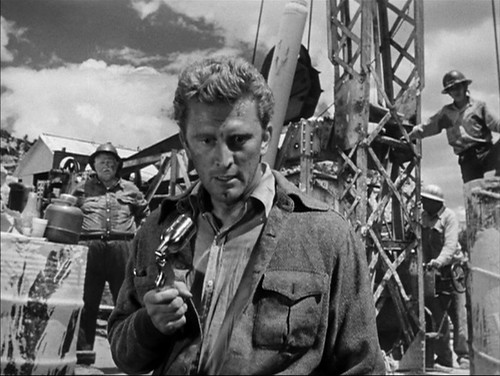
For me, Billy Wilder's insanely caustic Ace in the Hole is one of the greatest films ever made. At the time it was released, it was a box office flop and most critics were none too happy with its scathing attacks on journalism. I suspect people were turned off by how closely Wilder took aim at the audience itself, completely exposing the idiocy of the American populace and equating them to sadistic vultures. While the film may not look it on the surface, it is one of the great film noirs out there. The setting is actually not unfamiliar ground for noir, since movies like Out of the Past and On Dangerous Ground do bring themselves to the open spaces of the countryside. Ace in the Hole certainly has its share of noir-ish moments as well, but what I like about it the most is how it manages to completely ridicule the media circus and the society out of which it was born. That it was made during the height of the Hays Code is even more astounding. Kirk Douglas really does give one of the great performances out there, and Chuck Tatum does belong on a list of deeply flawed, yet fascinating characters that includes Fred C. Dobbs, Hank Quinlan, Dixon Steele, Jim Wilson, and more. 

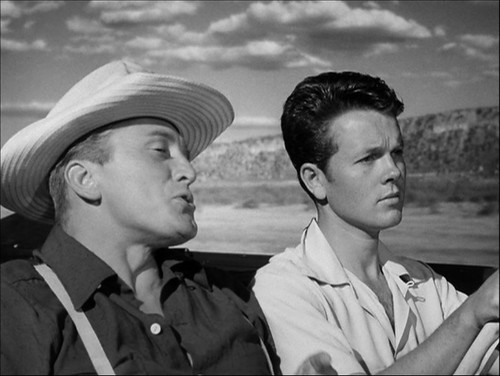
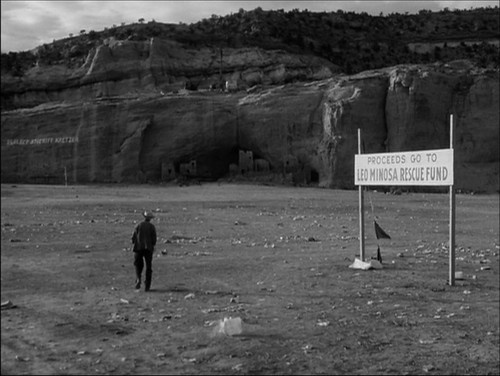
The film tells the story of Chuck Tatum, an out of work newspaperman looking for a big story amidst the vast emptiness of New Mexico, hoping that it will shoot him straight to the top. He stumbles upon Leo Minosa, who's trapped under an Indian burial ground and exploits the situation into a full blown, 7-day rescue operation. The film is one of the finest indictments of the media circus and the blood-thirsty unwashed masses. 

Jim Emerson of the Chicago Sun-Times has an "Opening Shots Project" at his blog. His belief is that all great movies can be understood by examining their opening shots in detail. It is like the first paragraph of a book that sets the stage for what's to come, thematically and literally. I think I'll give it a shot with Ace in the Hole:

2 Ace in the Hole

Here, we are introduced to Chuck Tatum riding in a car that's being towed while reading a newspaper. From this, we can see that Tatum is an opportunist. He does not create something novel so much as ride on the coattails of others and feed off of them. The shot implies he is a parasite/rodent/pest, and the film will later show that this is something present in the great American masses as a whole.

Chuck Tatum: Newspaperman, Treasure Seeker, Opportunist

I do think Chuck Tatum is a parasite, but it would be a mistake to lump him in the same pile as the rest. He's in another class of parasites, the king of them all, if you will. Whereas the readers of his articles are essentially moronic, Chuck is intelligent, calculating, manipulative, and above all, he knows he's a parasite. We see him ask Mr. Boot for a job, prostituting his services for a price.

3 Ace in the Hole

He uses others, and gets used himself. Tatum is also self-destructive, an alcoholic who doesn't even need a drink to send him over the edge. He is self-catalytic, auto-igniting his own inevitable destruction as he clamors to the top. The image of him lighting a match on the typewriter exemplifies this, and also shows that he is an impetus for the media circus, with the typewriter as his spark. 

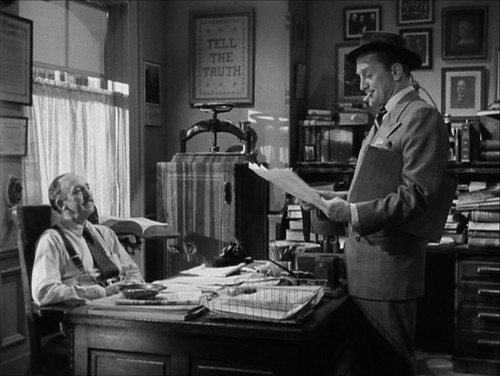
Mr. Boot is perhaps the most prominent of the admirable characters, and even his role is minor at best. In terms of principles, he and Tatum are two sides of the same coin. His slogan: "Tell the Truth" is scoffed at by Tatum, who fantasizes about a story involving rattlesnakes loose in Albuquerque, with him pulling the strings. He's the kind of newspaperman who engineers a story to his fitting, completely flying in the face of Boot's ideals.

4 Ace in the Hole

He does, however, share many similarities to Boot. For instance, we see him talk about Boot's belt and suspenders as indicating how cautious he is. A year later working for Boot, we see Tatum wearing a belt and suspenders in exactly the same way. He is calculating and careful like Boot, but where they differ is that Chuck carelessly lets his guard down during his ascent (i.e., him taking off his suspenders when his old boss reluctantly rehires, thanks to Chuck's careful orchestration in the first place). 

Another is when he tells the soon to be starstruck Herbie Cook:

"Bad news sells best! Good news is no news."

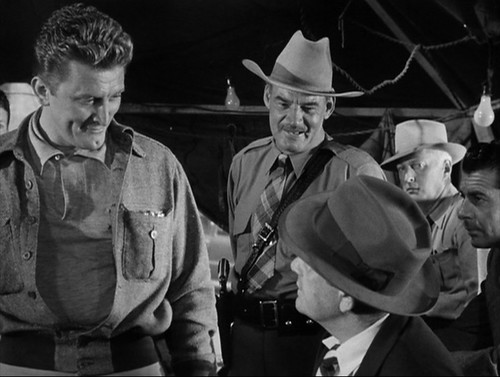
Right there he has just told one of the great truths of the film, so in that sense, he does tell the truth, just not on paper. One thing about Chuck Tatum is that he really does tell it how it is. Whether it be his monologues to Herbie about how the newspaper business really works, his extortion of Sheriff Kretzer, or his scenes with Lorraine Minosa, he's actually brutally honest. The only place he really outright lies is in the newspaper itself, to the public. 
7 Ace in the Hole

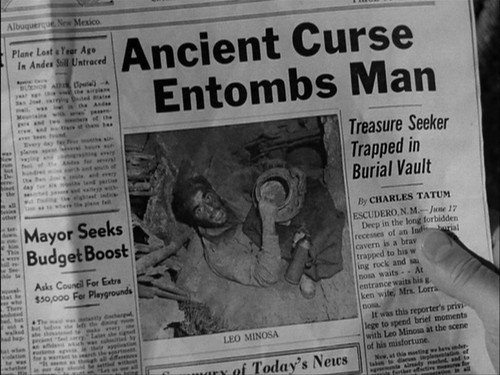
Chuck's characteristics extend beyond Boot alone, and I would say he's as much a treasure hunter as Leo. The only difference, of course, is that Leo is Chuck's treasure trove. One thing that's apparent from the first scene between Chuck and Leo is that nothing is sacred and there's nothing that Tatum won't do to get his story. There's no respect for the law as well as the ancient Indian burial ground. In that sense, I don't see Leo as much more sympathetic than Chuck. In fact, the Criterion dvd cover ingeniously puts Tatum's face in the newspaper article. Tatum is the "Treasure Seeker Trapped in a Burial Vault," and that vault is his own selfishness. He even tells Lorraine:

"There's three of us buried here. Leo, me, and you. We all want to get out and we're going to. But I'm going out in style. You can too, if you like."

Lorraine Minosa: "Loving" Wife, Femme Fatale, and Eve

I'm convinced the blackest heart in the film must belong to Lorraine. As bad as Chuck is, he at least tries for some redemption in the end. She, on the other hand, is consistently cold and careless towards her husband throughout the film. For starters, she uses Leo's captivity as an opportunity to run away after cleaning out the cash register, yet again. She even tells Chuck:

"Honey, you like those rocks just as much as I do."

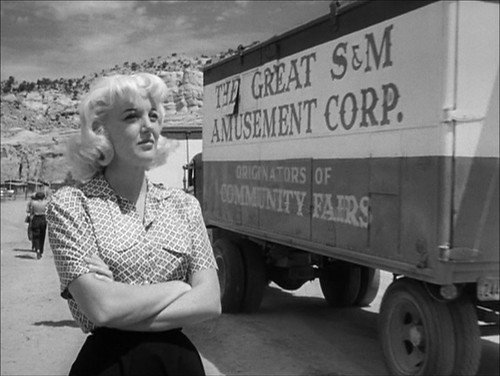
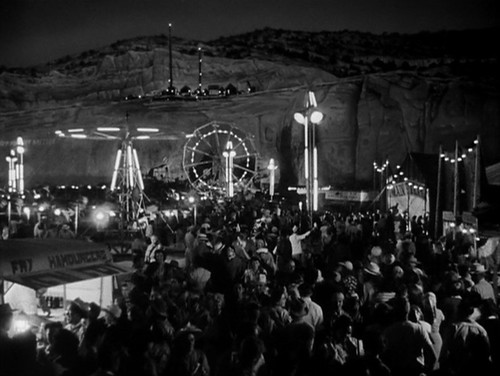
Just as she is about to leave, Chuck seduces her into staying with thoughts of selling hamburgers like hot cakes. The exploitation of Leo's situation by Lorraine is morbidly humorous. Each time we see the entrance to the burial grounds, the price jumps. First 25 cents, then 50, then it's a dollar. And "everyone pays. Mrs. Minosa says so." The icing on this crazy cake has to be letting the amusement park set up camp, giving a much more literal meaning to the term "media circus:"

11 Ace in the Hole

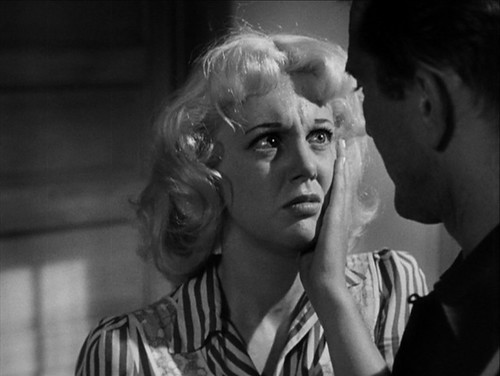
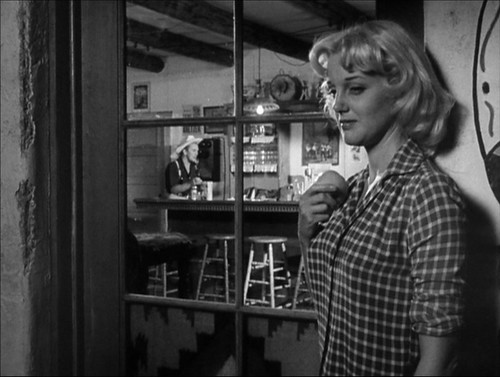
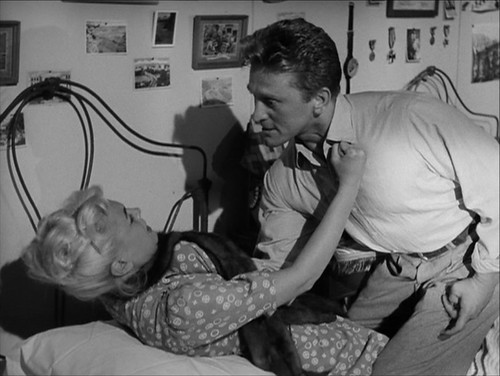
She is a femme fatale as well, and tries seducing Chuck on more than one occasion (or is it he who has seduced her?). The interesting thing is how little interest Tatum shows. Even Sam Spade, who still resisted such temptations at least showed some weakness. Tatum, on the other hand, seems to treat her more like an instrument. Completely the opposite to Jeff Bailey, he doesn't even flinch when she warms up to him, but rather brutally slaps her across the face:

8 Ace in the Hole

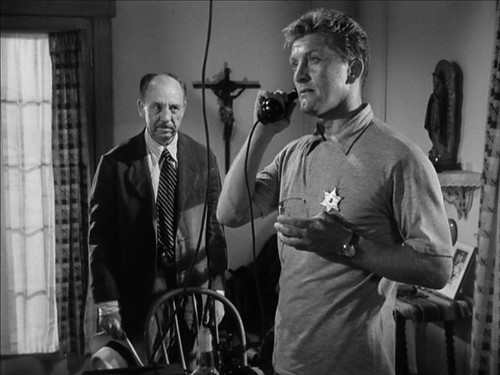
I definitely see a lot of religious context in Ace in the Hole. The ending in particular has a kind of desperate scramble for redemption on Tatum's part. Leo Minosa's mother too, seems to be constantly praying for her son. Then we get to Lorraine. Early on, we see her here, in easily one of the most famous biblical references out there:

6 Ace in the Hole

If Lorraine can be thought of as Eve, corrupted before she even has a chance, I wouldn't necessarily call Chuck "Adam." What is apparent is how Chuck, at least in my mind, ends up being slightly more admirable than Lorraine (with slightly being the key word). When he does finally realize the damage he's caused, you can really feel the disgust he has, for himself and the media monster he created. Lorraine doesn't show an inkling of remorse. I think the last time we see her, she is waiting for a bus amidst the masses evacuating themselves from ground zero. Chuck actually does seem to have some guilt (coupled with his own disintegration) over Leo's death. 
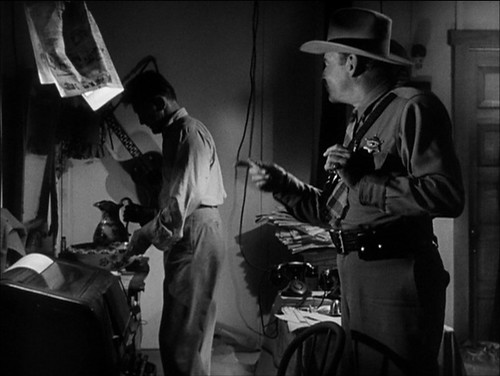
19 Ace in the Hole

I think it's important that we not reduce Chuck to merely a rotten apple (ha!). I don't really see him as a sadistic character and the real "villains" are the American populace, who gobble up whatever bad news comes their way. Chuck is really just using the hungers of the readers as a means of success. I wouldn't say he's benevolent by any stretch, because part of his desire to set things right is out of survival, but unlike the readers, I don't think he necessarily enjoys others' misery (except other newspapermen's).

Media and the American Public: Rapin' and Cannibalizin'

"We're comin', we're comin' Leo
So Leo don't despair
You are in the cave a hopin'
We are up above you gropin'
We will soon make an openin'
Leo!"

17 Ace in the Hole

I think the single ballsiest thing Ace in the Hole does is equate the exploitation of Leo's situation by the media (and subsequently the American people) as public rape. The lyrics of that decidedly cheerful jingle, which I only noticed after hearing Neil Sinyard's commentary, reveal themselves as really quite sinister. Obviously, they are "innocent" lyrics and the public doesn't have the intentions that are implied. But the audacity of slipping lyrics like that into the film, coupled with the obviously phallic drill pounding away, creates a really interesting allegory for the media circus. 

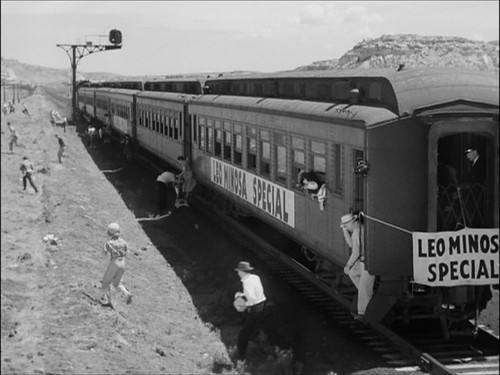
Thinking about the public as a mass of rapists aside, the more explicit and intentional allegory is probably equating the public to vultures, essentially cannibalizing their fellow man for amusement:

16 Ace in the Hole

That train's sign... what exactly is that intended to mean? It's like: What'll you be having today? Let's see, I think I'll try the Leo Minosa Special with a side order of fries and a vanilla milkshake. And I can't really think of any other way of reading that. At least with the song, the lyrics are innocent while implying some rather scathing innuendo. Here, it seems Wilder is saying to hell with it and pushing that boundary from implicit to explicit, since this is where the ridicule really reaches its apex.

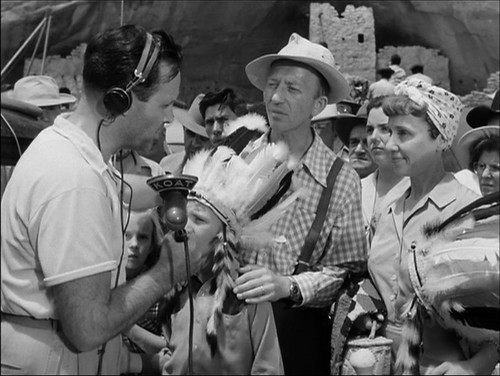
One of the more hilarious things in the film is Mr. Federber and his family. He's an insurance salesman (of course!), and when he first arrives on the scene, he tells his wife: "Wake up the kids, they should see this, this is very instructive!"

9 Ace in the Hole

His family is clearly meant to be the typical American family, and it's quite ridiculous (but nevertheless accurate) to hear him declare that his family was the first one there. Even his profession is apt. An insurance salesman is like a parasite, feeding off of the accidents of others. In the midst of talking on the radio, he even tries advertising his own insurance company! I think it's interesting and borderline deplorable that upon hearing of Leo's death, Mrs. Federber starts crying. It seems false, like she is putting up a show to make up for their enjoyment of the situation. 

Ultimately, the media circus is a short-lived beast that leaves as quickly as it came. 

22 Ace in the Hole

The brevity of the circus is the same as the value of the newspaper. It is daily, and rarely are newspapers actually treasured. They are read once, then tossed in the bin. As Tatum bluntly puts it:

"Tomorrow, this will be yesterday's paper and they'll wrap a fish in it."

Stories are short lived, and they must be burned quickly or else they'll evaporate. It's another way of thinking of a newspaperman as a parasite, jumping from one story to the next and having a feast when it's bad news. I'm reminded of Out of the Past, since Kathie Moffat is told: 

"You're like a leaf, blowing from one gutter to the next."

10 Ace in the Hole

I have a tough time deciding just how reprehensible Chuck Tatum is. On the one hand, he's the one who orchestrated the whole thing. Then again, there seems to be a desire to repair the damage (namely getting the priest and his own disgust at the media circus). The other newspapermen are, in some ways, even more blame-worthy. In the end, they laugh at the dying Tatum (albeit, not wholly undeserved) and are planning on exploiting the situation anyway with Sheriff Kretzer. I'm still not sure, but maybe Chuck had just burned up all the oxygen by that time and couldn't stand the caustic environment he created.

A Damn Dark Film

Ace in the Hole is a dark film. Spike Lee, in the video afterword says: "It's dark for 2007!" More so than even Sunset Blvd., I think, in part because it does strike closer to the bone, accusing the entire audience rather than "just" Hollywood. I can see why it wasn't popular in its time, especially when this was the image used for the promotional poster:

20 Ace in the Hole

Nevertheless, there are still some good, admirable people here. Actually only about three, maybe four. Of course, there is Boot:

12 Ace in the Hole

Boot, to be cliché, is the voice of reason. This scene reminds me of a confessional in particular, with the wire dividing Chuck and Boot. Herbie also figures into this scene quite well, since Tatum and Boot are his role models. Boot is certainly the most admirable character, for me, since he has a desire to save Herbie from corruption and wishes to expose Sheriff Kretzer's corruption within the boundaries of his own ideals.

Nevertheless, the more heartbreaking performances belong to Leo's mother and father:

15 Ace in the Hole

Well, there they are, the three uncorrupted characters I can think of. That shot of Minosa's father walking alone along ground zero is one of those devastating revelations. A case could be made for Smollett, but I personally wouldn't include him, because at the end of the day, he did fold to blackmail and extortion. 

Ace in the Hole is easily among my favorite movies of all time, and its corrosive attacks on the media and the public burn the flesh clean off of the apparent innocence of the bystander (in the final shot, who is Tatum looking at?). The performance by Kirk Douglas is my favorite of his as well (from what little I've seen of him), and certainly one of the great performances out there. Not to be outdone, Jan Sterling too, has a heart to match (and maybe exceed). The film is also a magnificent example of not-so-conventional film noir, and it's as black as night.
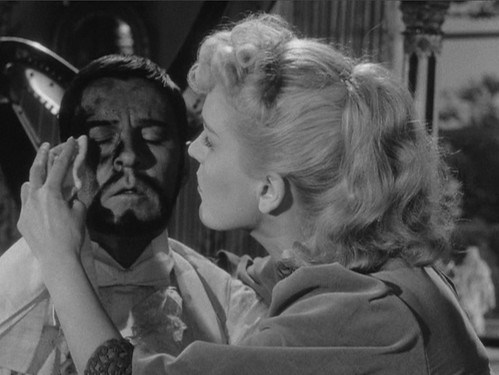
23 Ace in the Hole

Friday, May 15, 2009

Singin' in the Rain (1951)

Maybe spoilers?

Director: Stanley Donen & Gene Kelly
Screenplay: Adolph Green and Betty Comden
Starring: Gene Kelly, Donald O'Connor, Debbie Reynolds, Jean Hagen, Millard Mitchell, and Cyd Charisse

Images from the 2002 WHV 2-disc SE

13 Singin' in the Rain

Singin' in the Rain is the perfect musical, and while it's a superlative that's been beaten to death, it's no less true. The movie is not just a textbook example of what a musical does best, it is the textbook. Musicals, by their very nature, are expressionistic. The very best work because they divorce themselves from reality, since breaking out into song naturally involves smashing the confines of inhibition. The silent/sound era is therefore, an arena ripe for Singin' in the Rain to be set, since there have been few bigger changes to convention than the advent of sound. 

Á la Sunset Blvd.

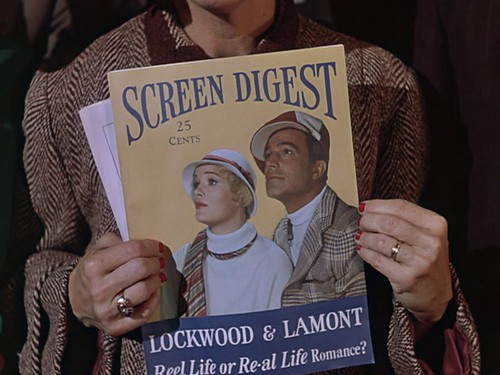
Singin' in the Rain is the Sunset Blvd. of musicals, in part because both films are exposés of Hollywood and cut straight to the bone. Whereas Sunset Blvd. focused on the destructive nature of show business, Singin' in the Rain aims at falsehood and the illusion that movies present. The first 10 minutes rapidly fire one satirical jab after another, and it's amazing how unchanged the world of celebrity worship is after more than 50 years. There were fan magazines way back then:
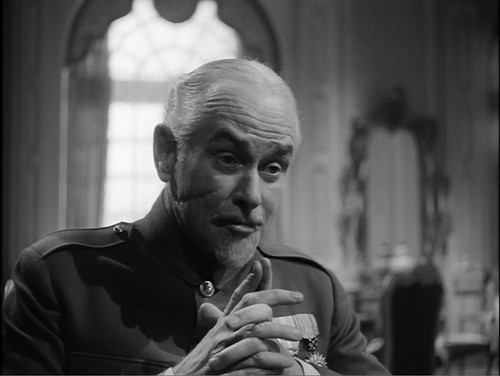
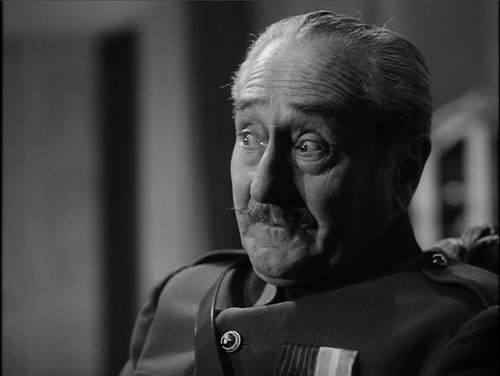
1 Singin' in the Rain

If these seem tame by today's standards, that's understandable. Nevertheless, it's truer than ever that the media forges farcical relationships/feuds in the eyes of the masses, and they are often built off of the screen personas and the roles actors play. The suggestible power of the movies was perhaps greater back then, when the media tended to elevate their subjects rather than drag them through the mud like today. There was more mystique about the celebrity that made them seem supernatural, whereas nowadays, we instantly get Youtube videos of celebrities walking barefoot out of a gasoline station restroom.

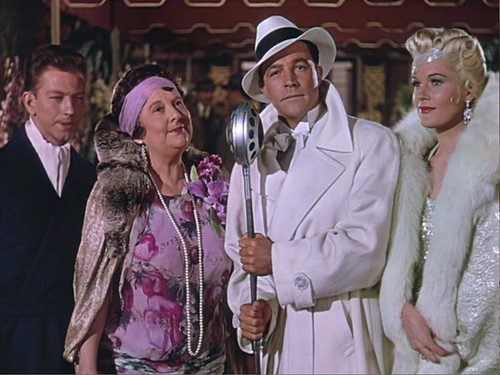
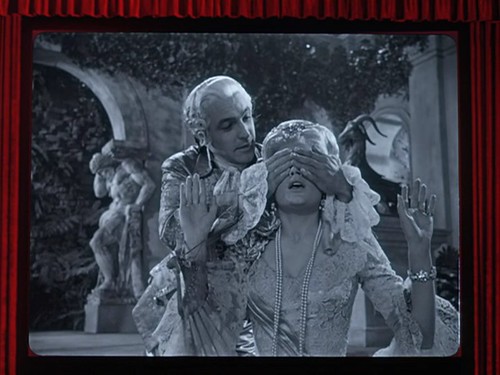
What makes Singin' in the Rain so much fun is that it knows the difference between illusion and reality and invitingly lets us in on the joke. Don Lockwood's speech is so funny in a way that only cinema could do it. Literature cannot successfully create the sort of contradiction that's presented. Here we have Don Lockwood and Lina Lamont, the two living screen legends at the premiere of another one of their silent romances:

2 Singin' in the Rain

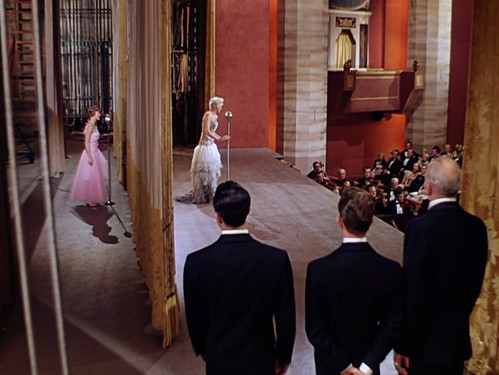
On the red carpet, they look every bit of movie star they're playing, and Don prevents Lina from speaking  (with a voice like nails on a chalkboard) by giving a lengthy speech on how Dignity has shaped his career. Virtually everything we see clashes with what he says, from Don and Cosmo's vaudeville acts, to Don's roles as a stuntman, to his relationship with Lina, and the "sunny" weather in California. Lina (boldly played by Jean Hagen) is brimming with vanity and is amusingly convinced by the fan magazines that she and Don are indeed an item. I love that line Don tells her:

"There's nothing between us... just air."

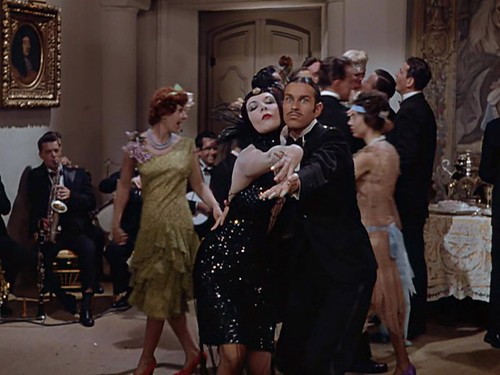
1951 nostalgia for the 1920s

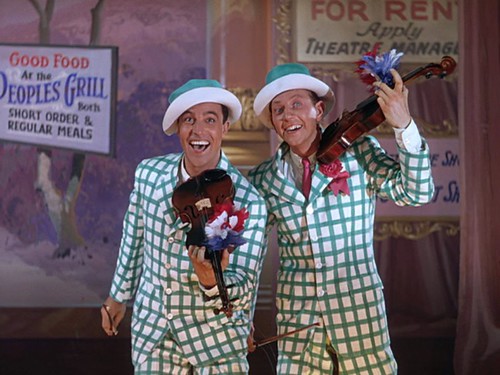
Musical comedies are like siblings to the screwball comedy (Some Like it Hot, for instance, does have a few musical numbers), and they are generally aware of their own silliness. The "Fit as a Fiddle" number has Don and Cosmo with a goofy grin on their face:

3 Singin' in the Rain

It's silly, yes, but the acrobatics the two pull off is astounding. It's as if the only way to get that good is to not take yourself seriously. The heart of Singin' in the Rain lies in its own self-deprecation of sorts. The red carpet announcer for instance, says the countess and her husband have been "married for two months but are still as happy as newlyweds." Here's the countess:

5 Singin' in the Rain

If this seems parodic, part of it may be that Singin' in the Rain is a retrospective of the late 1920s and as such, draws caricatures of the people from there. Mind you, this is the same countess who calls the talking picture: "vulgar." As a throwback to the 1920s, the film also has fun with the technical aspects of the transition to sound. Complete with the sound getting out of sync, we also realize how silly pantomime looks when coupled with sound:

12 Singin' in the Rain

What becomes apparent through these scenes is how cobbled together a movie really is. The separate elements can be teased apart, mixed together, and pretty soon, we have actors speaking in voices that aren't even theirs. And yet, when done properly (and on purpose), it all comes together beautifully through the editing. It's only when the unveiled illusions are exposed unintentionally that you realize how absurd a movie really is. I recently saw a work-print version of X-Men Origins: Wolverine, which still had CGI models lacking their skins, so they were obviously fake. Becoming aware that you're watching a movie is not always a bad thing (If....), but when the intention is to convince the audience of a reality and this becomes exposed, the film becomes a laughing stock. I find this happens more with films that take themselves seriously, which is perhaps why musicals tend to be both parodic and self-aware.

Self-awareness and Breaking Inhibition

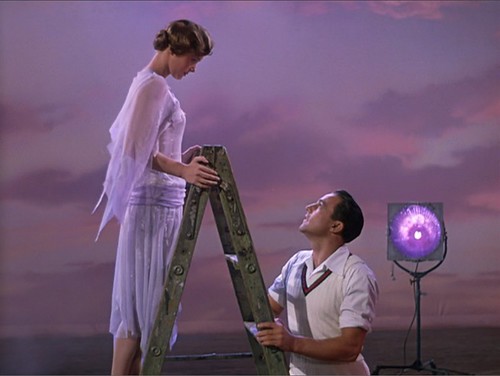
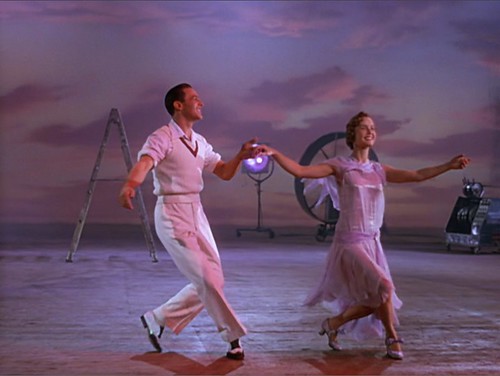
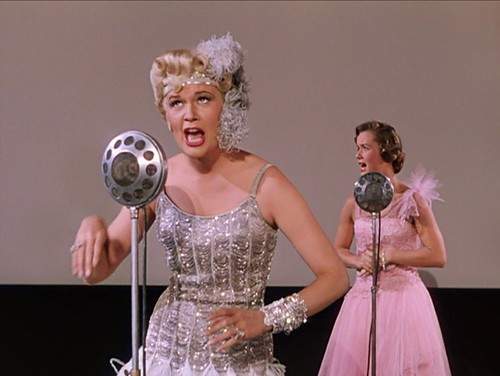
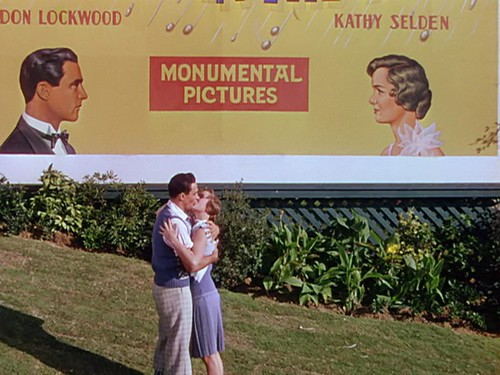
Singin' in the Rain reaches one of its many zeniths of self-awareness during the "You Were Meant for Me" number. What remains so fascinating about this particular scene, for me, is that the fictional emotion is real while still being fictional. In this scene, Don is admitting his love for Kathy, and rejecting the falsity of the Lockwood & Lamont relationship. In this sense, the emotion he feels for Kathy is "real" and the emotion he feels on screen (on our screen) for Lina is just acting:

8 Singin' in the Rain

9 Singin' in the Rain

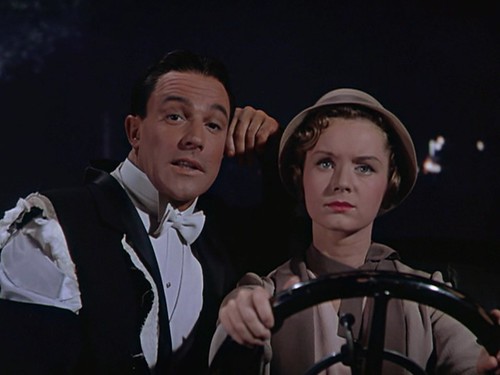
Yet when we consider the working relationship between Gene Kelly and Debbie Reynolds, this adds another layer of illusion to the picture. Apparently, Gene Kelly disparaged Debbie Reynold's dancing abilities, and was considered somewhat tyrannical on set. That none of this is apparent in the final product mirrors that hilarious scene where Don and Lina are filming a silent scene. During that scene, Don verbally jousts with Lina while romantically wooing her on film:

"Donnie, you couldn't kiss me like that without meaning it."
"Meet the greatest actor in the world. I'd rather kiss a tarantula."

That the "You Were Meant for Me" number takes place on a stage, with filming equipment and all, seems to be pointedly emphasizing the notion that this is just make believe. It's also interesting to note that the scene begins, and ends with them separated by the ladder. This also hints at a wariness on their parts, perhaps uncertain of their newfound emotions.

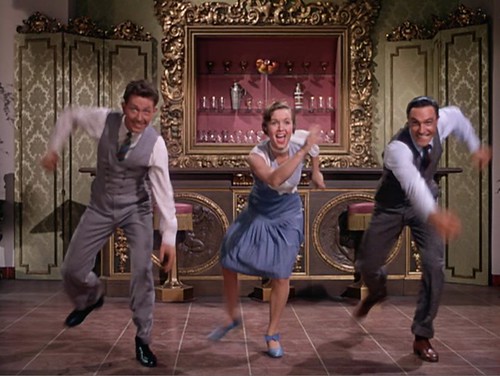
 I wouldn't say Gene Kelly or Debbie Reynolds are the greatest actors in the world, but the fact that they convey genuine feelings on screen regardless of their working relationship shows just how influential the illusion of cinema can be. Part of this that works so well stems from giddy persona that Gene, Debbie, and Donald put forth. There's a glee that's almost parodic and sort of like the Astaire and Rogers musicals. They knew they were good, and they didn't mind making fun of themselves for it:

14 Singin' in the Rain

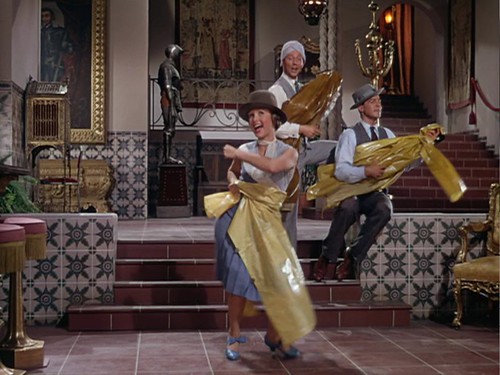
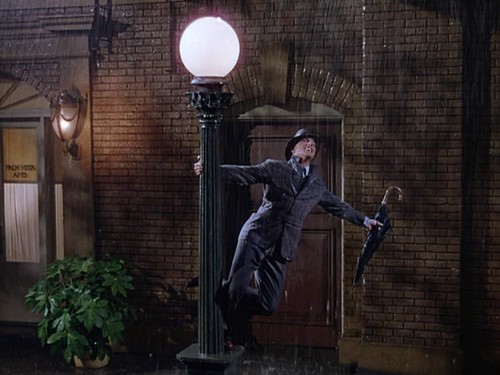
The twin centerpieces of the film, the "Good Morning" and "Singin' in the Rain" numbers are the epitomes of joy, and their energy comes from that overwhelming sense of happiness. For me, the other numbers ("Moses Supposes," "Fit as a Fiddle," "Make 'Em Laugh") have an obvious parodic quality that these two numbers seem to lack. "Good Morning" is arguably my favorite, simply because it's the whole gang just letting loose and doing what they do best. But the title number is rightfully the most iconic. 

15 Singin' in the Rain

The number embodies what musicals do best: break free of inhibition in an expressionistic manner. The umbrella is a wonderful symbol of that inhibition, as he first plays with it while getting soaked, then frees himself from it entirely and allows his true emotions to wash over him. If the "You Were Meant for Me" number has a hint of uncertainty, by the time "Singin' in the Rain" comes around, Don is convinced of his genuine love. The former number perhaps has a degree of wariness, whereas the latter is filled with total conviction. 

Like many musicals, Singin' in the Rain allows the audience to be "in" on the joke. That is, the audience knows that musicals are far from reality and it shouldn't really matter. It's the idea of breaking barriers that's important to musicals like Singin' in the Rain. In fact, there's a lot of "wall breaking":

Whether it be the 4th wall when Don slyly tells how lonely movie stars really are:

4 Singin' in the Rain

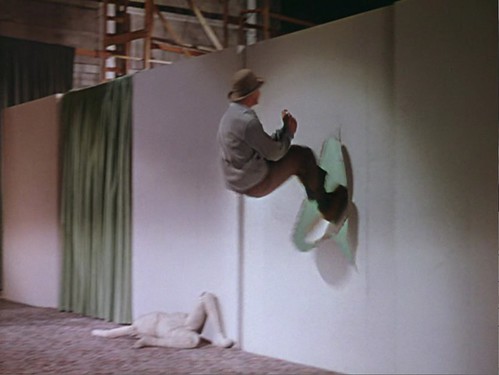
Or the set wall during "Make 'Em Laugh":

7 Singin' in the Rain

This number is difficult to represent with a single screenshot, since a still photo invariably removes the kinetics that Donald O'Connor had, so it's best to just watch the movie. The number proves how meaning can be had in even the zaniest of scenes. For me, I see this as a question of the value of art over entertainment, and Cosmo completely laughs at how it's generally seen as either one or the other:

"And you can charm the critics and have nothin' to eat
Just slip on a banana peel 
The world's at your feet"

It's almost as if the film's saying: you can make art or entertainment, but you can't make both. But with that, the film disproved its own argument, because it's definitely a wonderful piece of art that's sublimely entertaining. Nevertheless, there is some truth that entertainment and art aren't always hand in hand.

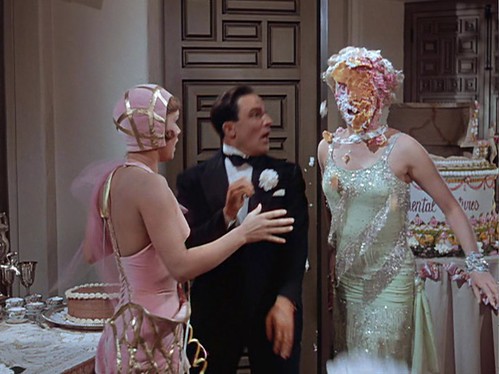
Other wall breaking, such as the old burlesque pie-in-the-face bit, this time on a big movie star instead of a clown (or maybe the two are one and the same?):

6 Singin' in the Rain
 
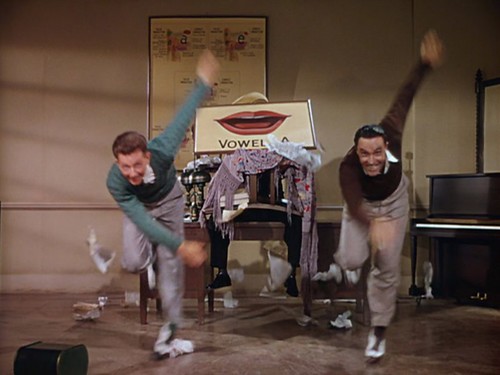
There is also the wonderful "Moses Supposes":

10 Singin' in the Rain

Again, there's that parodic demeanor of poking fun at the serious. The sheer bravura of Gene Kelly and Donald O'Connor is one of my favorite things about them, in part because they defuse any smugness with glee. Talent like that, well it must be taken lightly by them.

The Cyd Charisse Numbers

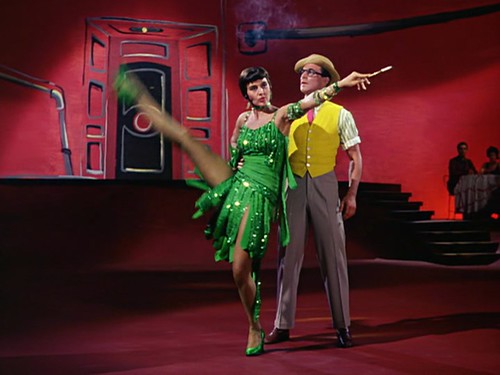
17 Singin' in the Rain

Well, since it's almost been a year since Cyd Charisse passed away, I felt like giving some more attention to the wonderful "Broadway Ballet" number she's so prominent it. Her elegance gives a kind of class that the tap dancing numbers may be limited by. This section of the film is really a film within a film, and at first, it seems to have nothing to do with the main storyline, but thinking about it makes me feel it is possibly representative of the temptations encountered in Hollywood.

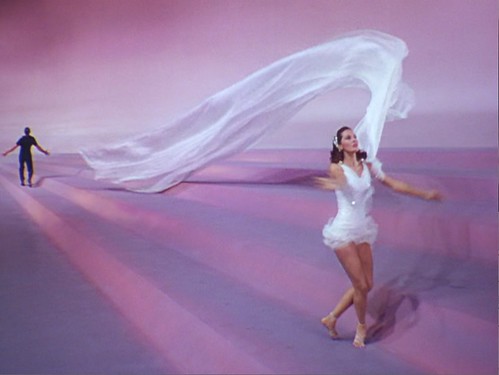
We first see her in a smokey (yet totally staged) café, and the first shot is of her shapely, long leg, at the end of which is perched Gene Kelly's hat. It's a seductive, intoxicating dance, and on a completely different level than the innocent numbers like "You Were Meant for Me." Of course, she is wearing emerald green, the color of envy. After this brief flirtation, Gene Kelly is whisked away by his agent and becomes a big broadway star. Eventually, he meets her again at a party, only this time, she is clad in white. They imagine dancing together in their minds set against a background in limbo. 

18 Singin' in the Rain

The choreography of this scene is simple, yet beautiful. She is almost the femme fatale of the number, having seduced him before in her green dress. Here, he again succumbs to her charms and the two become wrapped together in the incredibly long silk of her dress. Eventually, they must part, because he realizes there can be no real future with a gangster's mistress. Their meeting is strangely ambiguous, and I can't decide whether I should be rooting for them or not. It's the same feeling I get from watching Jeff Bailey and Kathy Moffat in Out of the Past. At times, I too, succumbed to her charms and wanted Jeff to be with her.

Singin' in the Rain: A movie about itself

In addition to being the Sunset Blvd. of musicals, I would posit the film is also the 8 1/2 of musicals as well. Not only does it expose the ins and outs of Hollywood, it also explores the nature of film itself. The sham Lockwood & Lamont movie persona, contrasted with the genuine one between Don and Kathy comes very close to the screen personas of Astaire and Rogers and their real relationships. This division between reality and movie-illusion culminates in the final scene:

19 Singin' in the Rain

The curtain, of course, represents the silver screen itself. There is the screen persona (Lina) and the person behind that image (Kathy). It's fitting that in a musical, where barriers are constantly broken, the curtain finally be pulled to expose the truth:

20 Singin' in the Rain

And I must commend Jean Hagen, who probably has the boldest role in the movie. Her role is probably the single most fun, and her Oscar nod was well deserved. An interesting thing I just learned was that her "dubbing" by Kathy is actually her own normal voice, which kind of adds an extra twist to the whole persona thing.

Singin' in the Rain is very much a movie with itself as its subject, just like 8 1/2, although I prefer the musical, personally. The film, I think, has been echoed in Robert Altman's The Player, which also ends with referencing the title of the movie you've just seen:

21 Singin' in the Rain


Saturday, February 28, 2009

Paths of Glory (1957)

There are spoilers for Paths of Glory and one small spoiler for Barry Lyndon.

Director: Stanley Kubrick
Screenplay: Stanley Kubrick, Calder Willingham and Jim Thompson
Starring: Kirk Douglas, Ralph Meeker, Adolphe Menjou, George Macready, Wayne Morris, and Richard Anderson

Images from the 1999 MGM release.

17 Paths of Glory

Stanley Kubrick's Paths of Glory is possibly the most affecting film experience I've ever had. I admit that I once thought everything Kubrick did was genius and each film an absolute masterpiece. I've probably gone over his readily available films more than any other director. As my experience has changed, some have grown in my mind more than others, and I no longer make blanket statements about his oeuvre. There are three of his films that I cannot decide upon which is the greatest, and if I were to make a list for the Sight & Sound poll, I could put any one of them on it. These three would be Paths of Glory, 2001: A Space Odyssey, and Eyes Wide Shut.

I can only think of one other film at the moment that has as much emotional resonance as Paths of Glory, and that film is Robert Altman's Nashville. I find that film endlessly fascinating and it too, could go on my Sight & Sound list. But I'll save that for a later post.

Paths of Glory tells the story of a failed French attack on the fictional German-controlled "Ant Hill." The generals arrange a court marshall indicting three men to be executed as an example for cowardice in the face of the enemy. The film is one of the great examinations of war as well as the hierarchal structure of the military and the ideas of subordination.

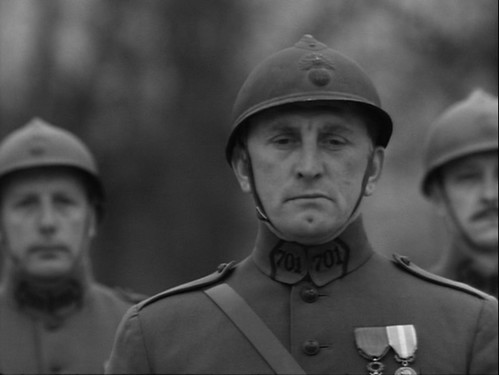
The film opens with the Marseillaise, which was used in Casablanca, but here, it serves not to rally us in unity and patriotism, but to question the ideas of unity and patriotism, and to what extent they can exist selflessly. However, Paths of Glory is not opposed to the ideals of Casablanca so much as cautious of accepting declarations of patriotism. It is a warning that utilizes themes throughout much of Kubrick's work. The one that sticks out the most for me is the idea that culture does not elevate us to nobility. Paths of Glory expresses these notions throughout the chateau scenes, where the generals calmly discuss strategies like a chess game. General Mireau (George Macready) is ordered by General Broulard (Adophe Menjou) to order his men to take the strategic position known as the Ant Hill. I find these scenes particularly sinister, and Mireau's scar certainly helps.

1 Paths of Glory

When I look at Mireau, I wonder where he got that scar. Was it in battle? Or did he obtain it in a more questionable manner? Perhaps he's trying to look "battle worn?" In a lesser film, I feel we would have gotten a flashback or a story telling us where he got it and why it made him the man he is today. Paths of Glory is a wisely simple film, and because of that, it's messages are strong and concise. There are few films as economical and as effective as Paths of Glory.

One of the important ideas that Paths of Glory tackles is the military hierarchy. Mireau, after all, isn't even the top of the food chain. He is ordered by General Broulard, who has even less screen time than Mireau. Of course, Broulard has his orders too, however we never see or hear about these faceless leaders.

2 Paths of Glory

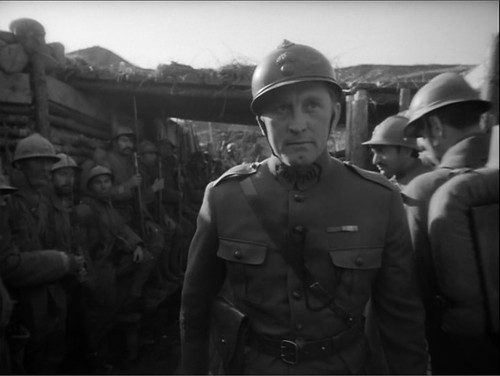
The scenes of the trenches have that indelible Kubrick stamp, with Mireau surveying the men and asking them all the same question: "Ready to kill more Germans?" The trenches really are a perfect allegory for war as a means of dehumanizing the enemy. I will discuss this more in the final scene, which is one of three perfect scenes I can think of in the film. Kubrick's films always feel like they belong in a different universe than ours, yet the problems faced are exactly the same, only amplified.

4 Paths of Glory

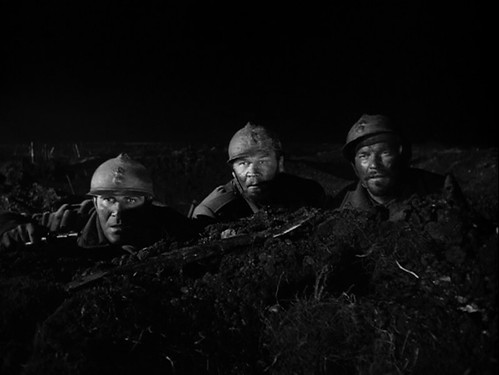
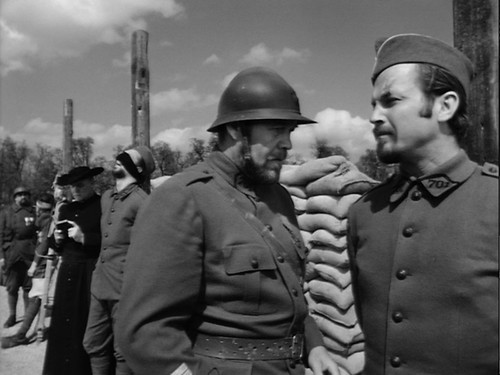
War films always have a knack for instilling fear and dread, and the reconnaissance scene is chilling. In the scene, Lieutenant Roget (Wayne Morris), Corporal Philippe Paris (Ralph Meeker) and Private Lejeune scout amidst no man's land into German territory. There is a moment where a flare is shot, and to me, it was like it kicked open my mind to the horrors of war as we see the ground strewn with the bodies of men. Adding to this is Roget's cowardice, who inadvertently tosses a grenade in panic... and kills his own man, Lejeune.

And what does Roget do when he abandons Paris?

5 Paths of Glory

Why, look how clean he is! It's like he just took a bath...

Flaws of superiority on the small scale, as well as the large scale are evident throughout Paths of Glory, and the film wisely does not convey a continually escalating blackguarded sense as we rise in the ranks. Just as I find excessive naivete and bliss difficult to tolerate, I cannot easily sit through films that suck out any glimmer of hope. Paths of Glory does not tag everything as horrible, which is part of the reason I'm not particularly fond of A Clockwork Orange. Then again, Ace in the Hole is one of the darkest films I've seen and it's one of my favorites.

Speaking of which, I think Paths of Glory and Ace in the Hole prove just how capable Kirk Douglas is. He's a bit like Humphrey Bogart in that regard, who was also willing to play unsympathetic sons of bitches.

6 Paths of Glory

Douglas plays Colonel Dax, who isn't the top man, and it's quite evident that the further you are from the battlefield, the more of a scoundrel you are. As Dax tells Mireau:

"Patriotism is the refuge of scoundrels."

In general, the higher up the officer, the bigger the bastard. I watched Robert Altman's M*A*S*H today, and there's that same criticism of hierarchy. Of course, M*A*S*H is a satirical piece, and for the most part belittles the influence of commanding officers. Paths of Glory, on the other hand, emphasizes this influence.

Colonel Dax gives me hope for humanity, and it makes it that much better that he is benevolent without being morbidly pious (unlike Frank Burns in M*A*S*H).

8 Paths of Glory

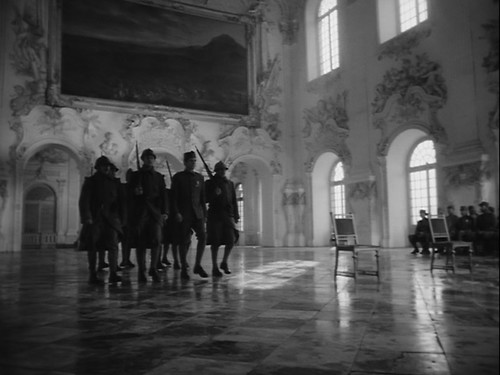
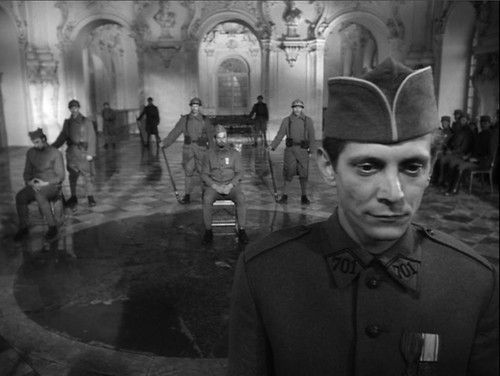
Although the first half of Paths of Glory is absolutely brilliant, it pales in comparison to the second half, which has three perfect scenes. The first of these, in my mind, is the court marshall. Set in the picturesque chateau, it is the perfect place for Kubrick to convey one of his favorite ideas: that culture fails to elevate us to any real nobility. After all, Hitler himself collected artworks and once aspired to become a painter. In the establishing shot, for instance, we get the prisoners being escorted to the trial:

9 Paths of Glory

Above them is this massive painting. Giant paintings and other art in the hands of cultured scoundrels are also found in A Clockwork Orange, Barry Lyndon, and Eyes Wide Shut. This notion of art as being incapable of justifying our civility is one of Kubrick's ideas that resonates strongly with me, perhaps because it strikes so close to the bone. I can't help but feel guilty when I watch films like this. It's almost like I feel that watching war films and being aware of the horrors of war is enough to appreciate what millions of men lost their lives for.

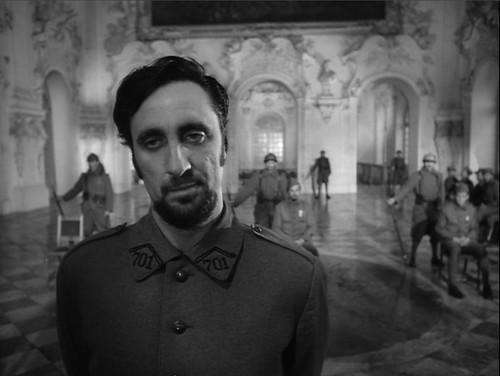
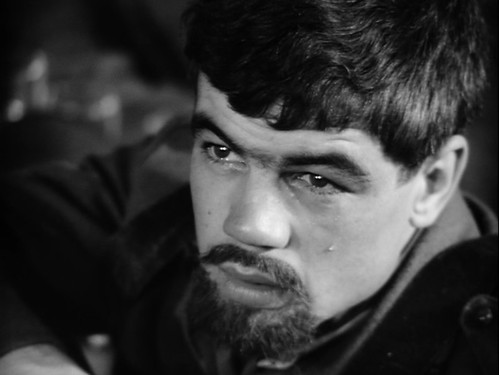
There are three men who are selected to be made examples of. Each is selected a different way, none of which are "fair." However, I do not believe there is a fair way to pick any man at all, given that the order itself is unjust. The first of these men is Private Ferol (Timothy Carey), who is picked on the basis of being a "social undesirable."

10 Paths of Glory

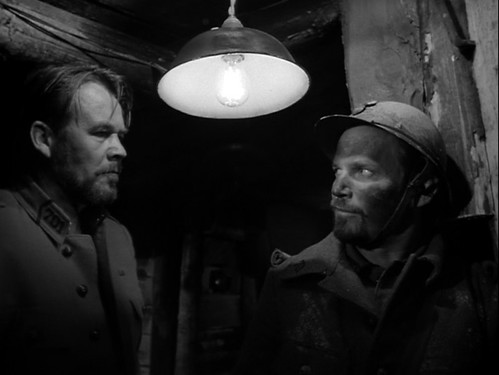
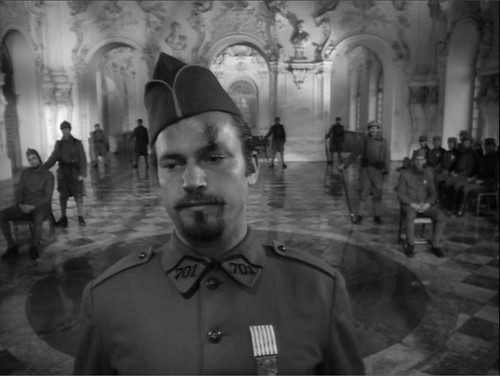
Like most people (I hope), I am adverse to any form of prejudice, and choosing a man to die simply because he's a misfit is as wrong as how Corporal Paris is picked. Lieutenant Roget picks Paris as a means for saving his own skin, which of course, parallels Mireau's own form of covering up his misdeeds. At the very heart of Paths of Glory's attack on hierarchy is protecting one's reputation first and foremost as a means of fulfilling personal interest. This is the "path to glory" that the title implies.

12 Paths of Glory

So if picking a man to die out of prejudice, spite or self interest is wrong, is there anything that comes close to "fair?" I don't believe there is a definitive answer to that, but I would say no. The "fairest" is by chance, and this is how Private Arnaud is picked. I suspect most people would say being picked by chance is the fairest way... unless you are the one being picked.

11 Paths of Glory

The random expendability of men in times of war is equally evident in Barry Lyndon during the small "skirmish" during which Captain Grogan dies and both armies basically march toward the other and fire randomly at the enemy.

A short digression:

Deciding on a near perfect movie is entirely subjective, though there are precious few that I'd add to the list. The one that comes to mind most frequently is Rear Window. That particular movie just doesn't get old, and actually grows in fascination. I may add Rashomon as well as La Dolce Vita because they too, seem to get better with each successive viewing. After watching Paths of Glory for probably the 6th time, I think I can add it to the list. The strange thing is that I was impressed, but not blown away by it the first time. I think it's a bit odd, but I find that the films that hold up best with multiple viewings don't necessarily have a strong impression on the first viewing. Is that just my changing experience in the world of film? I'd say my first impressions of Barry Lyndon and Dr. Strangelove, for example, were much stronger than Paths of Glory, but since then, it has risen to the top.

And back on topic:

When Howard Hawks was asked what makes a great film, he said:

"Three great scenes, no bad ones."

Paths of Glory is near perfect for me because I cannot find a single shot, much less a scene, that doesn't have some purpose or effect. Stanley Kubrick's films all have a strong visual component, which is possibly why he's so revered among filmic circles. Of course, visuals alone are not enough to make a film great, and I am wary of saying I like all his films even though I admire them. Paths of Glory, in particular, stands out in my mind as having a clear visual presentation. Such as the first trench scene with the low angle tracking shot that is characteristic of many Kubrick films.

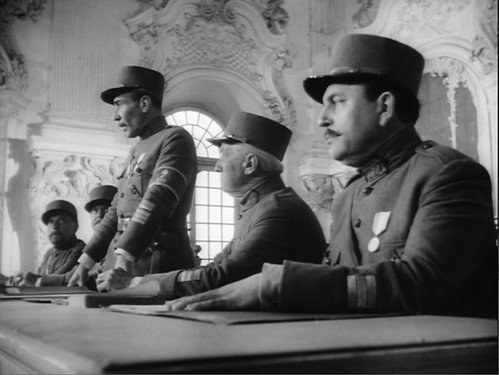
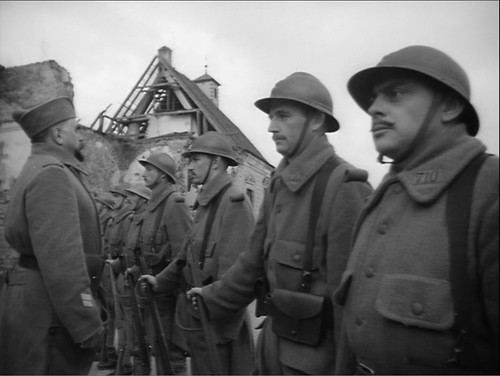
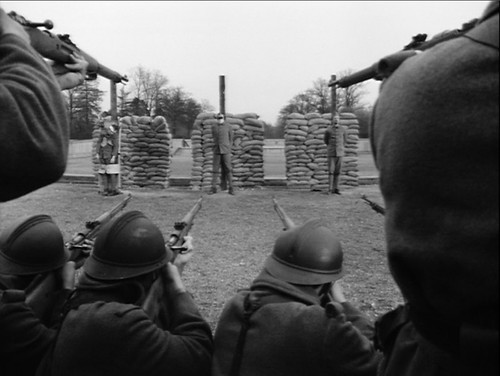
At the end of the court marshall in particular, is a concise visual comparison between the judges for the trial and the execution squad:

13 Paths of Glory

14 Paths of Glory

Image comparisons like these work in the purest sense of cinema. I've said before that I'm not a fan of exposition for the most part, and the visuals achieved in Paths of Glory are more poetic than any amount of verbal narration.

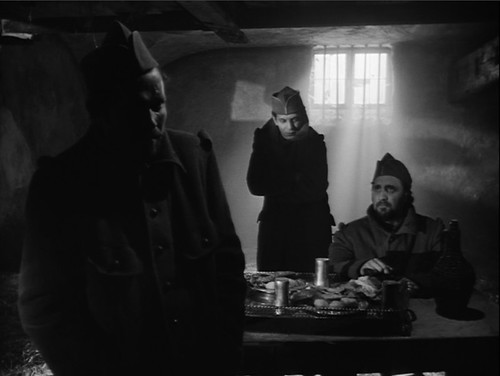
It's funny how viewing two films in the same day at random can draw some nice comparisons. For instance, M*A*S*H and Paths of Glory both have a "last supper" scene and while the former is amusingly stagey, the latter is decisively more raw and de-glorifies the sanctimonious air of the old story. Like M*A*S*H, I find Paths of Glory does have a very dark humor to it, although much more minimal.

There is, of course, the famous scene where Paris says:

"Tomorrow we'll be dead and that cockroach will still be alive. It'll have more contact with my wife and children than I."

To which Private Ferol squishes it and says: "Now you've got the edge on him."

The other one that comes to mind is where Arnaud rejects the notion of absolution and embraces his wine bottle and recites:

"This is my religion. Oh, Great Bottle, forgive me my sins, for now I lay me down to sleep. Bo-peep. May I drink of you first? Thank you. Amen."

15 Paths of Glory

The second scene that I find perfect is the execution. Droning on and on about every single shot would not do it justice, I think. Each man dies in a different manner, and they make me wonder just how I will go myself. There is Ferol, who earnestly and openly doesn't want to die, and is consoled by the priest. I think it would be too easy to read this simply as "faith is for the cowardly." While I am not at all religious, I feel that the way each man deals with death is understandable. The blindfold around Ferol is as much a shield as it is an indication of fear. The term "blind faith" comes to mind, and not necessarily in a pejorative sense. Faith, to me, is simply another way of coping with problems in life.

One of the more gratifying scenes is where Colonel Dax orders Roget to oversee the execution. I wonder whether I'm entirely justified in finding that so satisfying. If a man is earnestly unwilling to kill a man, this means he's not entirely heartless. Or is he simply afraid of guilt? I do not believe the two are mutually exclusive. Yes, he may be trying to preserve his own conscience, but doesn't that indicate compassion to some degree? Roget obviously deserves more punishment than Paris, but even an inkling of respect for another human being's right to live makes it feel wrong to enjoy Roget's duty as executioner.

18 Paths of Glory

Paris faces his death with a straight face, and when Roget apologizes, I again get a sort of mixed gratification from it.

Private Arnaud is unconscious and tied to a stretcher, having been knocked out the night before. For me, it is the final nail in the coffin exposing the absurdity of military punishment.

19 Paths of Glory

I think Paths of Glory carries lots of similarities to Dr. Strangelove, but I feel Paths of Glory is the superior film, both thematically and emotionally. Dr. Strangelove feels decisively more apocalyptic, giving a final conclusion that we will end up in nuclear holocaust. For me, the ending of Paths of Glory is more affecting and dark, not only because it is more realistic, but because it indicates no end whatsoever to the cycles of war and the internal struggles for power.

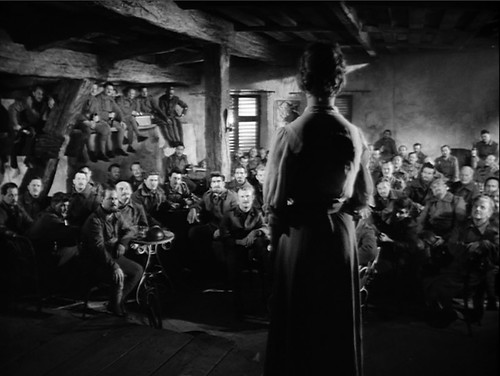
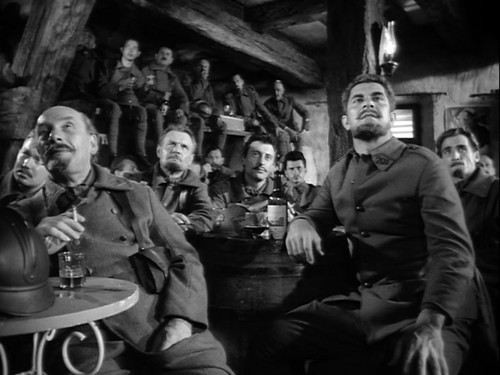
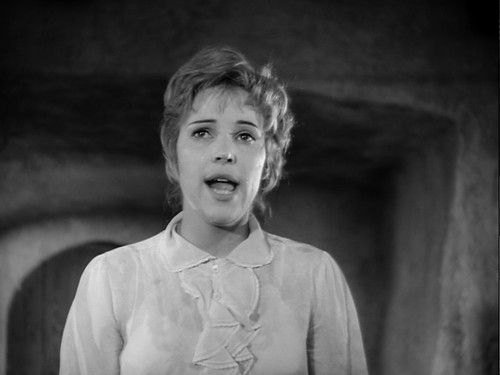
The last scene is one of the most emotionally affecting scenes I've seen in part because it works on so many levels. It begins with a bar full of half-drunk French soldiers jeering and taunting the "latest acquisition from the enemy," a young German woman clearly terrorized. The host at the bar appropriately calls her:

"A little pearl washed ashore, by the tide of war."

21 Paths of Glory


20 Paths of Glory

22 Paths of Glory

As she cries, she begins to sing, at first inaudible amongst the cacophony of male banter. As this fragile and wavering voice soars above the catcalls and whistles, the men gradually fall silent. It is in this moment that they realize this "pearl" is the so-called enemy... this human being, so fragile and scared is the one they've been fighting. They have lost sight of the humanity in the enemy, and it is this that moves them. As they slowly join in song, a silver lining appears amidst the darkness of this film. Although war is terrible and millions of people die, there is always the hope that we will not lose sight of the "enemy's" humanity.

23 Paths of Glory